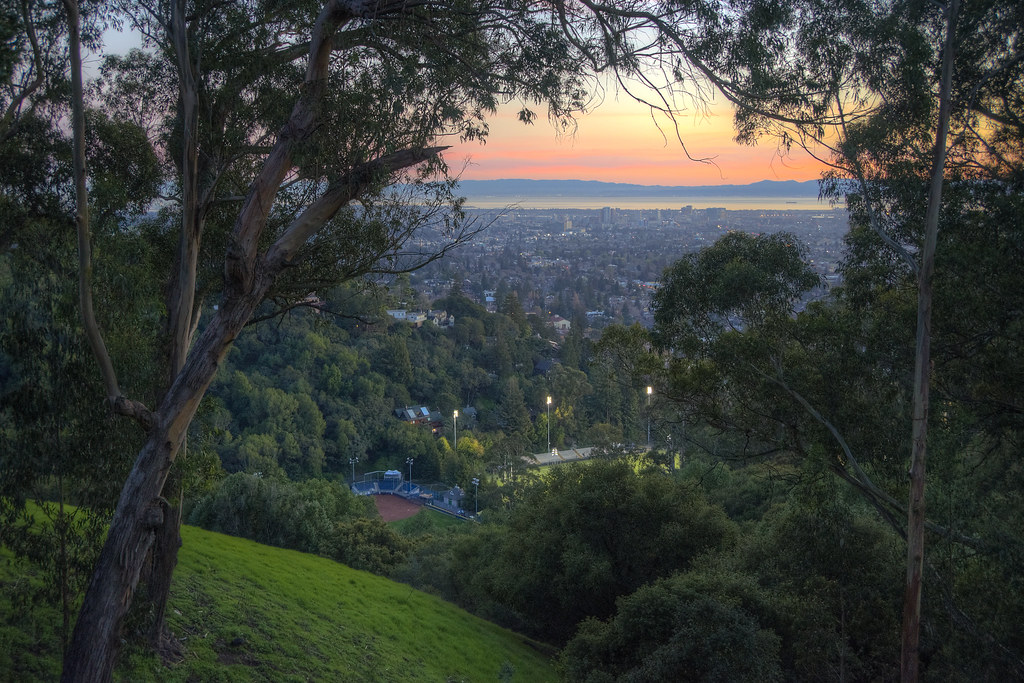
My past couple of posts have been images of San Francisco, foregrounded by nature and suburbs—the style I like to call a “civilization gradient”. This image similarly presents downtown Oakland, California, past the hilltop homes and Cal fields of Strawberry Canyon and through the invasive alien leaves of Berkeley Lab’s eucalyptus trees. The HDR processing techniques that Brendan and I use are perfect for settings like this, with an array of light intensities across a broad landscape.
Tag: Oakland
Birdblur
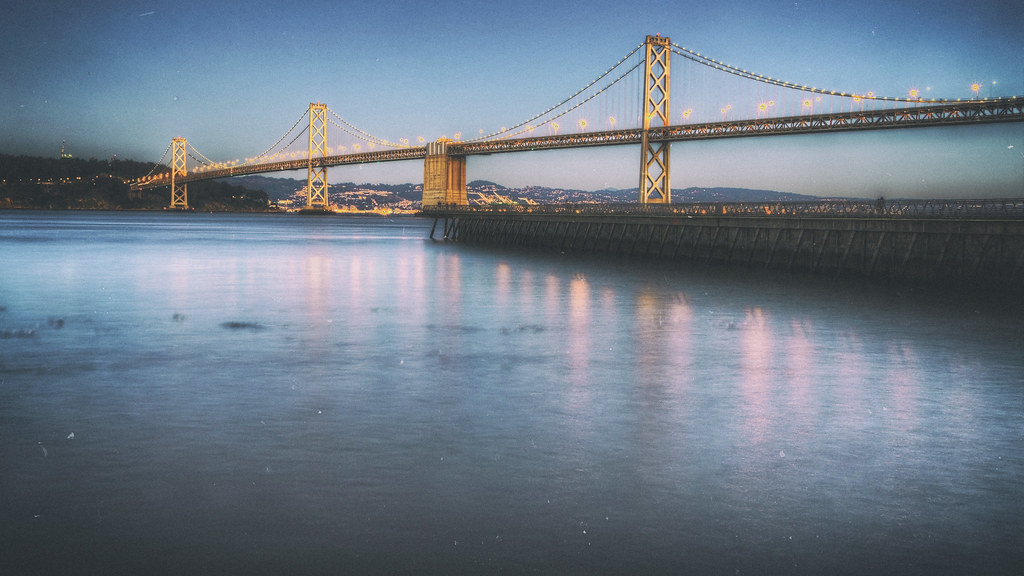
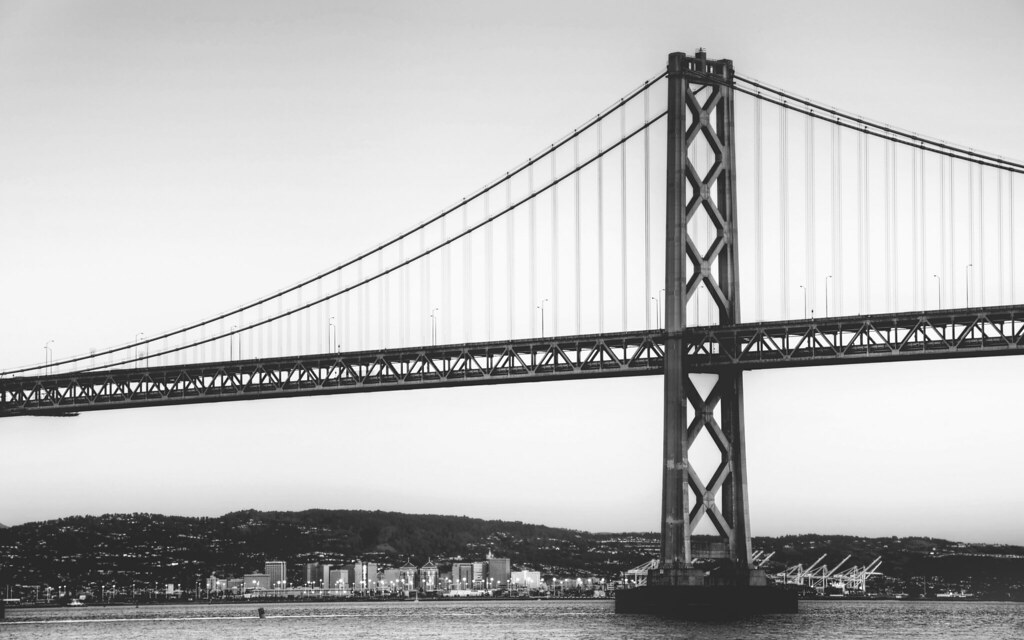
If this week on Decaseconds has had a theme, it has been structures suspended over water at sunset. It has also been a week of long-exposure shots that live up to the site’s title. Hoards of gulls riding on the waves are reduced to weird ghost-blurs in the foreground of the San Francisco Bay Bridge, Yerba Buena, and the Port of Oakland.
Campanile Bars
Campus, Bay, and City
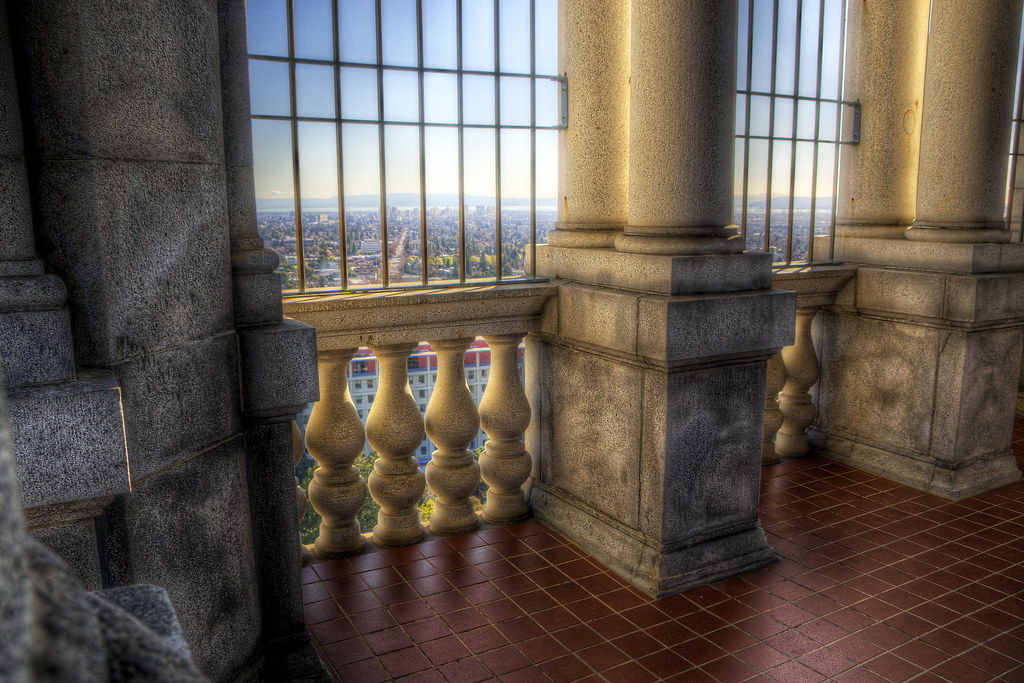
The view from atop Berkeley’s Campanile is a nostalgic one, with San Francisco and Oakland popping up in the distance above the sprawl. Walking along those broad, slightly cracked, and sun-baked pathways of Berkeley’s campus never quite felt natural, though. Can a place magnified beyond human scale feel that way?
Span Aside
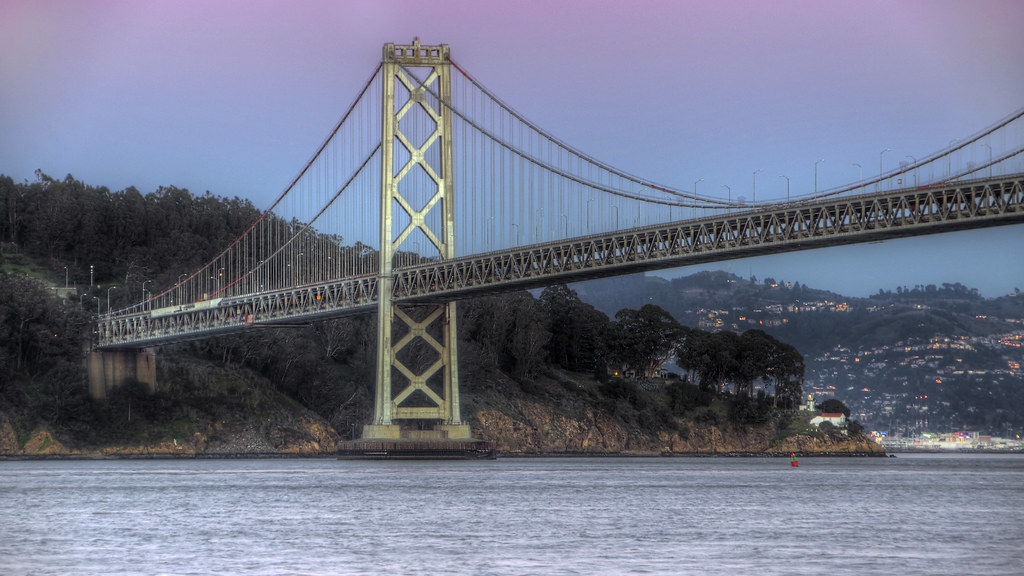
This photograph is a double-case of finding interesting details by looking away from the obvious. On one hand, this subtler image was captured opposite an intense sunset over San Francisco. The color palette is heavy with pastels, but accented with a few harsh reds from Oakland in the distance. In the image itself, there’s a tiny building under the right-hand span of the bridge. Seeing something so (let’s say) adorably sized next to something so dominant and enormous makes for a charming contrast.
Golden Gate and Bay in the Rain
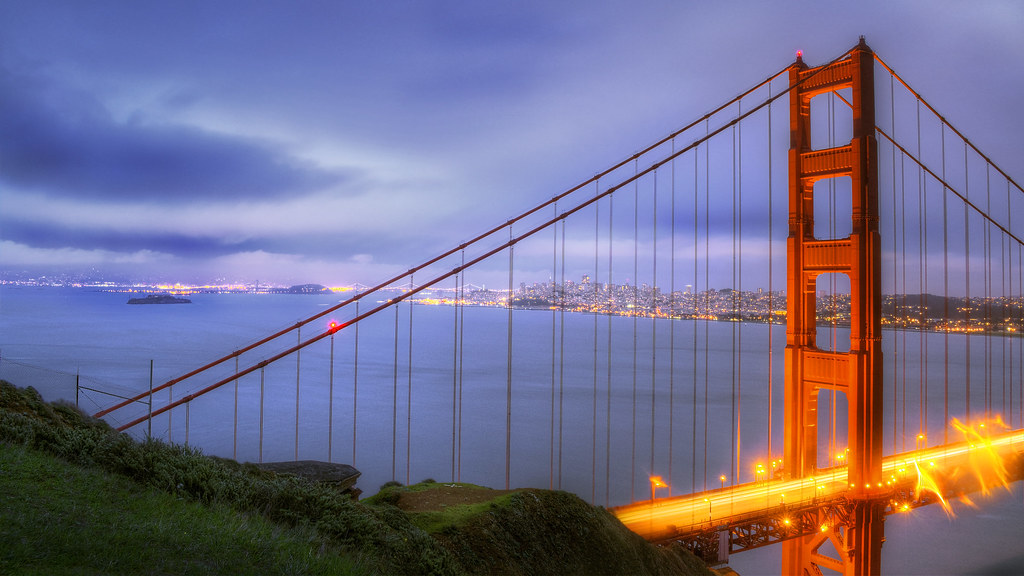
I sometimes sift through the RAW files I took long in the past, searching for meaning in images I captured long ago. In the case of this particular photograph, there’s more to the image than just my favorite Bay Area gradient of differing environments (e.g. Oakland and San Francisco and Alcatraz and two different enormous bridges and so on): there’s also a feeling of place and moment. The dramatic clouds and the grasses and the hint of the Golden Gate’s span are all spectacular, but the optics of a raindrop spattered across the lens add just as much to the image. You can practically smell the petrichor in the air.
Old Modern Shapes
At the dawn of the twentieth century, all was hopeful and “excellent.” When the Bay Bridge opened in 1936, human ingenuity could solve any problem, bridges replaced ferries, cars replaced horses, aircraft would soon replace trains. Now we’re orphans of the future, living in a world when “modernity” is in the past, and epic symbols of the era and its architecture are quickly becoming relics. Though I have no nostalgia for much of the social/cultural mores of the time period, I do find it fascinating to look upon the structures built “for the future” from the standpoint of that future. Perhaps it makes me wonder, just a bit, what we build for our own future now.
Beyond Berkeley
Time-Space Material
I’ve posted before on the strange properties of Berkeley and the Bay Area: the condensation of nature and suburb and weird architecture and intensity urbanity that compresses human interest and life into a tiny area. This high-density material seems to deform the very fabric of space a time, and make the distance of a few miles seem like a light year and the time of a decade seem mere moments. This photograph captures the folding and crinkling as it happens: crunch clouds, sharp trees, an array of buildings from multiple Berkeley colleges within the University, the stretch of Telegraph Ave. and the tiny shapes of Oakland (at the far right) in the distance.
Shattuck Rooftops
Looking south, over the rooftops and streetlights of downtown Berkeley, the high-rise buildings of Oakland and Emeryville are luminescent ghosts in the bay fog. I’ve come back to this photograph again and again—the composition isn’t quite right, the quality is just average, but for some reason I find it inescapable. I can forgive all of its sins (and mine in taking it) for the trajectory of those sodium lamps, arcing gently to the south like some fairy worm.
Last Light: Port of Oakland
This is Telegraph Ave.
A mid-winter shot down Telegraph Ave. to the heart of Oakland (from the top of Berkeley’s Campanile) is more nostalgia-tinged now than when I took it. And I do appreciate the way that this shot captures the Bay and the hills ringing it, the silvan suburbia of the East Bay, and even the oddly broad California streets.
Ultimately, even with the benefit of nostalgia, I still have mixed feelings about Oakland. In some ways, the existence of Oakland allows San Francisco to be an “unbalanced chemical equation,” pushing off many of its problems across the bay. Everything can still look peaceful from a distance.
Perch
Civ Gradient
I often talk about the “civilization gradient:” the distance required to go from high-density urban land all the way to empty, rural space. Depending on when a given area modernized and switched from, say, horses to cars, this distance can vary drastically. In “older” parts of the US, like the east coast, the gradient was largely established by feasible distances for travel by horse. On the west coast, an area largely developed after the advent of the car, this distance is usually much longer. The best exception to this is the Bay Area, where various parks around the “lip” of the Bay’s “bowl” effectively compress the distance.
In today’s photo, the whole array of Bay Area landscape is visible: the forests and trails along the peak, the industrial buildings of Lawrence Berkeley National Lab, the quasi-sprawl of Berkeley and Emeryville, and the full urban metropolis of San Francisco at the edge of the clouds.
Grizzly Peak Trail
Up here in the Berkeley Hills, the entire Bay Area stretches out on a clear day. In the distance is Piedmont and the Oakland Airport, but I particularly engage with the sense of scale that the preposterously-steep fire trail adds to the image. There’s a space for humans in the sprawl of the East Bay.