Berkeley Still Life

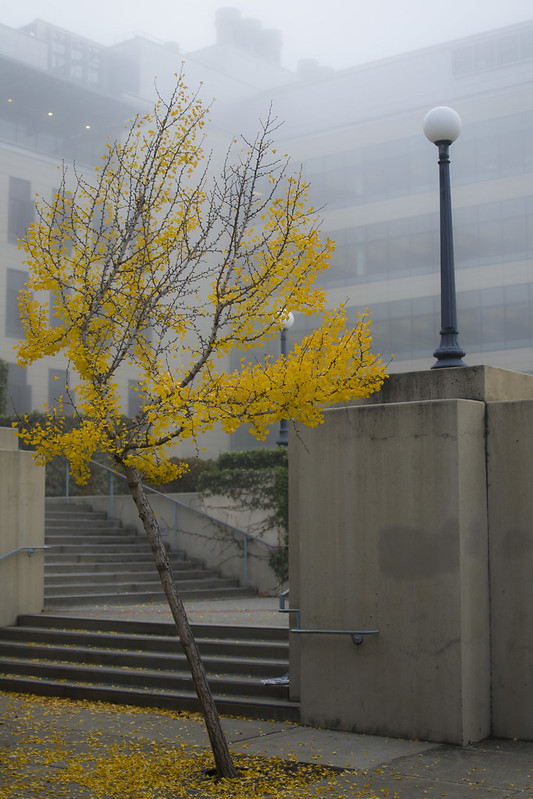
Berkeley is a pretty surreal place; as I process that, I thought my 400th post on Decaseconds might be a great time to really show it. The yellows of the birch tree are so sharp on a foggy fall morning, amid the hard, stained concrete of the past and the high-tech Li Ka Shing Building (one of my first-ever posts) materials. Visual contrast, both literal and metaphorical, align with the conceptual contrast of a place that prides itself on being countercultural while also being the birthplace of many of the technologies and ideas that make our modern culture possible.

Berkeley Still Life

Descent: Latimer

This was a sight, descending the steps to the courtyard of Latimer Hall, that was once everyday and pedantic to me. Now, the sight of it is a powerfully nostalgic mix of strange perspectives and a dozen mishmashed textures and patterns: tiles and bricks and precast and cast-in-place and trees and bushes. In the long run, that red-green-and-gray color scheme means a lot more to me than I thought it did.

Descent: Latimer

Columbia of the North

Having recently finished the fantastic Bioshock Infinite, I’ve had images of early-twentieth-century American exceptionalism floating through my brain. No matter what you think of the (sometimes questionable) policy decisions based on such a policy, the iconography is undeniably seductive. Neoclassical design features and waving flags on a crisp Sunday afternoon! Though this moment on St. Lawrence’s campus might not be literally of that time, the spirit of it was overwhelming.

Columbia of the North

-29 ºF

After a (relatively) warm weekend, the North Country is set to be entombed once again in winter. Though we’ve been promised by the false weather prophets that this cold spell won’t match the ferocity of January’s efforts, I can’t help but think back to mornings of almost unreal atmospheric thermal energy. On the edge of St. Lawrence’s campus, the sky was clear and the sun rose and cars puttered to work as though everything was normal.

-29 ºF

Time-Space Material

I’ve posted before on the strange properties of Berkeley and the Bay Area: the condensation of nature and suburb and weird architecture and intensity urbanity that compresses human interest and life into a tiny area. This high-density material seems to deform the very fabric of space a time, and make the distance of a few miles seem like a light year and the time of a decade seem mere moments. This photograph captures the folding and crinkling as it happens: crunch clouds, sharp trees, an array of buildings from multiple Berkeley colleges within the University, the stretch of Telegraph Ave. and the tiny shapes of Oakland (at the far right) in the distance.

Time-Space Material

Vanish to Fog

Bit by bit, my memories of Berkeley are vanishing. I can justify that this phenomenon is, at worst, neutral: the daily grind and the stupid time I missed the bus vanish, and only the weekends watching the sunset from the Berkeley Hills remain. Not to be trite: this empty, early-morning, fog-shrouded, post-apocalyptic view of the campanile is now my memory of the place, as well as an operational metaphor for that memory… If that’s not too obtuse.

Vanish to Fog

Snow-Stone-Zen

Taking a temporary aside from Africa (and the warm/rainy weather of weird northern New York), here’s an image from the Zen garden just after the most recent blizzard. I haven’t done much work in black and white photography since high school, but this was a case of contrasting textures and tones that just demanded it. The rough, dark brick and stone dressed by puffy snow seemed poetic almost to the point of (again) cliché—so I went with it.

Snow-Stone-Zen

Under the bridge

This one’s a little different, here I was playing around with a pinhole on my Canon T3i. This is actually a manually measured 3 shot HDR pinhole photo of a bridge on Cal’s campus. Composing this shot was a bit of a challenge as really the only way to judge composition is to take a long exposure (in this case not that long with the help of very high ISO settings). Processing it was also a bit of a challenge as the amount of change in the lighting over the duration of the three exposures created really weird looking highlights. Still, the peculiar kind of “lo-fi” quality is neat, and I’ve been experimenting with landscapes where the reduction in detail is less noticeable.

Under the Bridge