Advanced Lab

Johnson Hall of Science is an unusually green building—particularly for one filled with hoods and hazardous chemicals. It also happens to have a truly surreal geometry that messes with your head a bit, if you let it. The ceilings have been sloped to better reflect daylight, reducing the need for electric lighting. The result is this Alice-in-Wonderland-esque lab space.

Advanced Lab

Cold Containment

Hyperbright hallways in the Energy Biosciences Building come straight from the set of a sci-fi movie. Between labs and storage space are cold room facilities like the one in the foreground of this photo, with its bank of controls on the wall outside. The research accomplished here lives up to the imposing appearance: the future of using biology to harness the Sun’s energy will be born here.

Cold Containment

Oak Snow Shelter

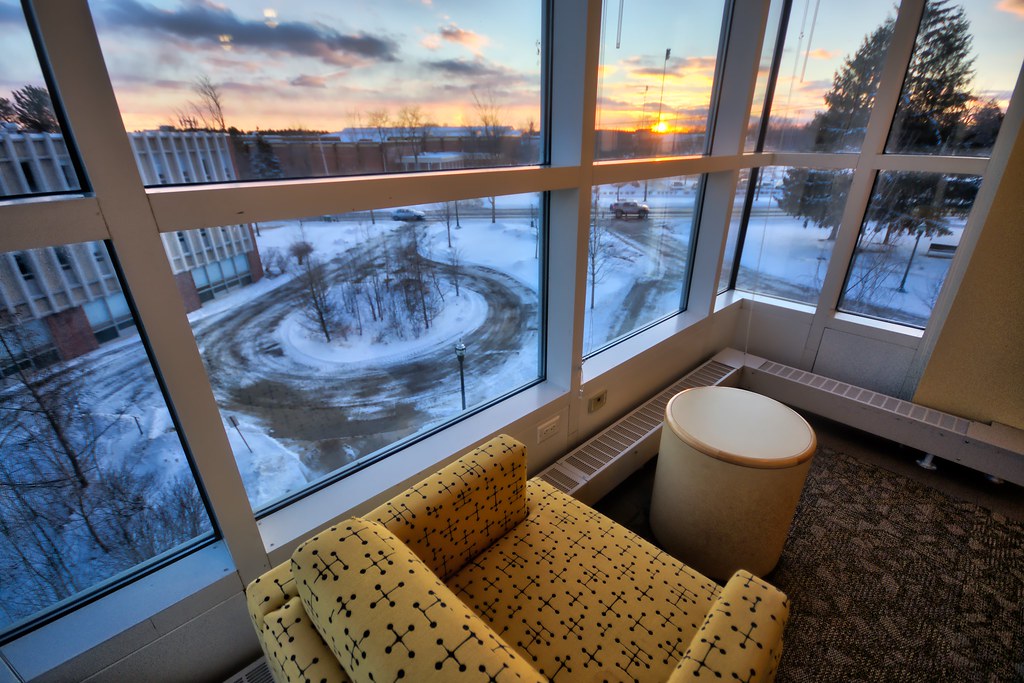
Snow comes early to the North Country. Nothing quite justifies a cold morning more than waking up to a lovely dusting of snow and flakes in the air. The oak trees are still stubbornly holding onto their leaves, and thus there was a cozy snow-free zone (and a welcoming bench) from which to watch the snow this morning. Johnson Hall of Science looks friendly in all seasons.

Oak Snow Shelter

Autumn Science Paradise

The benefit of teaching early morning classes: I’m finally (routinely) up for the sunrise. Even when the morning is cold and my fingers don’t want to be operating a camera, the fall and the clouds and the trees conspire to make Johnson Hall of Science (a frequent subject) look like paradise.

Autumn Science Paradise

Chemistry in Action

St. Lawrence University celebrated Parents’ Weekend on Saturday with a gorgeous fireworks display on the south side of campus. Conveniently, this is the sky above Johnson Hall of Science. The combination of architectural textures, floral fireworks patterns, and fall foliage make for an image that would be more at home in a video game than reality.

Chemistry in Action

Luminous Science

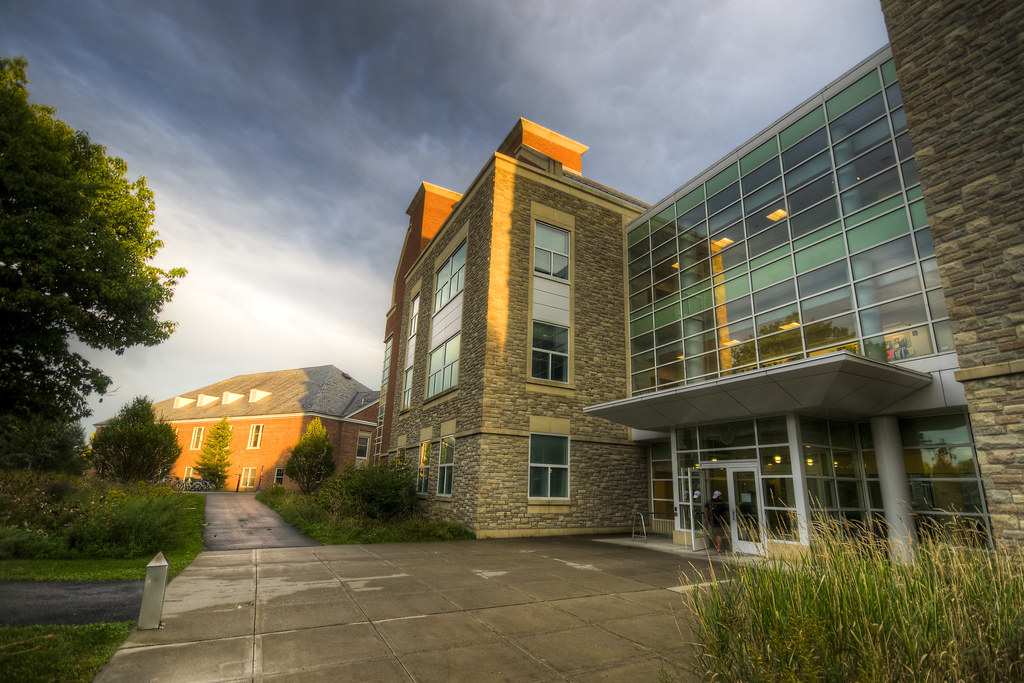
St. Lawrence University’s Johnson Hall of Science is a lovely, brand-new science building (particularly appreciated by chemists who prefer not to work in the miasma of their predecessors’ experiments.) The aesthetic benefits are supplemented by olfactory ones: in addition to excellent ventilation inside, the exterior of the building is surrounded by wild grasses and flowers that energize me the moment I step outside.

When viewed at night, the luminous quality of the glass facade lends the place a storybook look that I think HDR captures perfectly.

Luminous Science

Brand New Science

The beautiful, shiny, new Energy Biosciences Building in downtown Berkeley is a truly fantastic place to do science. Not only does it have some of the most gorgeous labs I’ve ever seen (with lots of great natural light), it also has meeting/lunch areas like these that do a ton to support the collaborative mindset that is so critical to good science. I wanted to do a multi-shot post today, descending from this glossy surface with its view of the Berkeley skyline (such as it is) down into the bowels of the center.

Science Lounge

For many of the biologists working here, the real science is happening down in the basement. Here, mutant and wildtype plants are growing in this incubator to a size where they can be cheerful participants in biofuel experiments.

The Incubation Chamber

And the really cool shot from just around the corner: seeds that have just sprouted, growing to a size that they can be planted in soil. From what my charming guide told me, many of these are randomly mutated seeds, and they’re being screened in this media to determine if any have the correct mutation for further experimentation. Behind this example, you can see numerous other sets, merrily growing away. (Or not, if they have this particular mutation.)


Sprouts

Hearst: Inside and Out

Today is a rare double-post, featuring my favorite structure on Berkeley’s campus: the Hearst Memorial Mining Building. This beaux-arts-style hall was finished in the early 20th century, and I find it particularly notable for two reasons (beyond just being aesthetically pleasing):

1. The interior atrium reminds me of the Bradbury building, and I get a fantastic cyberpunky (see Blade Runner)/steampunky (see Steamboy) tingle every time I step through the doors.

2. The building was updated in a seismic retrofit from 1998-2003, yet is still just as gorgeous as ever. This is a case of a putting a lot of effort into saving a building that is worth saving, and doing it in a way that doesn’t obliterate the elements of the building that were so appealing to begin with.

Hearst Edifice

Just pass those enormous, varnished wood doors is this stunning atrium. Today, I’m showing only a small part of it. Come Friday, I’ll offer a wider view of the space.

Hearst-punk

Big Science Moon

This was the scene over the Berkeley hills last week, as a massive full moon rose over Lawrence Berkeley National Lab. You could practically hear scientists howling, but I suspect that was more because their experiments weren’t working than because they were werewolves.

Given all of the processing that goes into producing an HDR image, I can’t exactly say that this image “hasn’t been Photoshopped.” When you get right down to it, every single image receives some sort of post-processing, even if it’s just to bump up the contrast. What I can say, however, is that the size of the Moon has not been artificially enhanced. Our celestial cousin really was that gorgeous and enormous on this particular evening.

Big Science Moon

Effusion Cell II

This is another photograph from a lab in the Charles Harris Group at UC Berkeley. I previously photographed this effusion cell apparatus from an orthogonal orientation, but I also found this shot at its long axis intriguing. The sense of complexity and purpose, but also the sense of aesthetic minimalism, always attracts me to physics apparatuses.

Effusion Cell II