The somewhat-reflective panels on the planar faces of Berkeley Lab’s Molecular Foundry make the pallet for the Bay Area’s winter colors.
Tag: lab
Lights of Building 66
Spectroscopy Lab
Approaching the summer solstice, the start of fall-semester classes and their attendant labs seems far away, but a new class of St. Lawrence first-year students will be here before I know it.
This was one of the light sources students were interrogating: a sodium lamp, like the ones used in street lights (at least in the twentieth century—LED street lamps are becoming increasingly dominant now.)
532 nm
In St. Lawrence’s Raman spectroscopy and microscopy lab, the most potent laser illumination source comes from a neodymium-doped yttrium aluminum garnet. This is a pretty ubiquitous laser source, but I happen to like it because it also demonstrates the value of nonlinear optics: though this laser is emitting light at 1064 nanometers (in the infrared), a suitable doubling crystal can combine two of those 1064 photons together to make a shiny new 532 nm photon.
Never Use Futura
Am I trying my hand at some sort of hipster chillwave/yacht rock album cover? No, just displaying my excitement to read Never Use Futura.
The Place and the View
During sabbatical, I posted a lot of views like the one below: A dramatic dusk view of Berkeley and San Francisco from Berkeley Lab’s Building 62, where I spent my days doing renewable energy research. Ending a productive day, I’d step out onto the balcony a 30-second walk down the hall from my office to find these views readily available (when the marine layer didn’t intervene).
But to my memory, I’ve posted few shots of that balcony that was so integral to the sabbatical experience. Circling around to the adjacent Molecular Foundry, I took this image that (in the top left) shows that small balcony (with sun conveniently reflecting), as well as some of the lab infrastructure around in it. In the foreground is the liquid nitrogen storage tank for the foundry with its radiator covered in ice.
Staging Area
Even in one of the most expensive real estate markets in the world, there has to be a place to store the equipment that makes everything run. In the foreground of this view from Berkeley Lab’s Building 62 are the shipping containers and assorted equipment used by the physical plant to keep the lab running. I’ve always found the contradiction—using very expensive land to store mundane objects—to be an engaging one. Of course, if all of the land were employed for its “valuable” use and the practical aspects were neglected, the result would be that the land would cease to be valuable.
This Is the Laser
The laboratories of physical scientists across the planet have pulsed laser systems like this one, and many look quite similar: a collection of squat boxes covering optics, electronics, and beampaths. Above or below the surface of the table are additional boxes of electronics driving the lasers and detectors. This particular system is special to me for two reasons: (1) most modern laser tables don’t have rad wood grain paneling, and (2) this was the instrument I used during my sabbatical at Berkeley Lab last spring. Lots of good data emerged from its photomultiplier tube.
Gathering to Watch from the Lab
Students from Berkeley’s campus climb as high up the hill as they can to watch the sunset behind San Francisco and the Golden Gate, but the barbed wire fence of the Department of Energy National Lab makes for a cut-off point. Far on the other side is Grizzly Peak: another great view, but one without the immediacy of this particular spot. Inside the perimeter of the lab, I had the opportunity to experience a set of perspectives both scientific and literal that are beyond the scope of everyday Berkeley life.
Quitting Time at the Lab
Snow covered northern New York this week, and the temperature rests in the single degrees Fahrenheit; now is an excellent time to look back at the warm eternal-summer glow of California. Particularly in contrast to the >60-hour-per-week graduate students down on campus, the “standard” workweek of staff at Berkeley Lab was a remarkably normal trend. At the end of the day, with that sunset light arriving, the workers who keep the physical plant running come outside into the evening breeze and head home.
Upgrading the Advanced Light Source
Berkeley Lab’s Advanced Light Source, a massive X-ray laser sourced from a building-sized particle accelerator, was undergoing upgrades while I visited. Construction in the area added an mundane veneer to the superscience happening inside.
California Convertible at Midsummer
Summer Camp ’17
Spectroscopy Lab
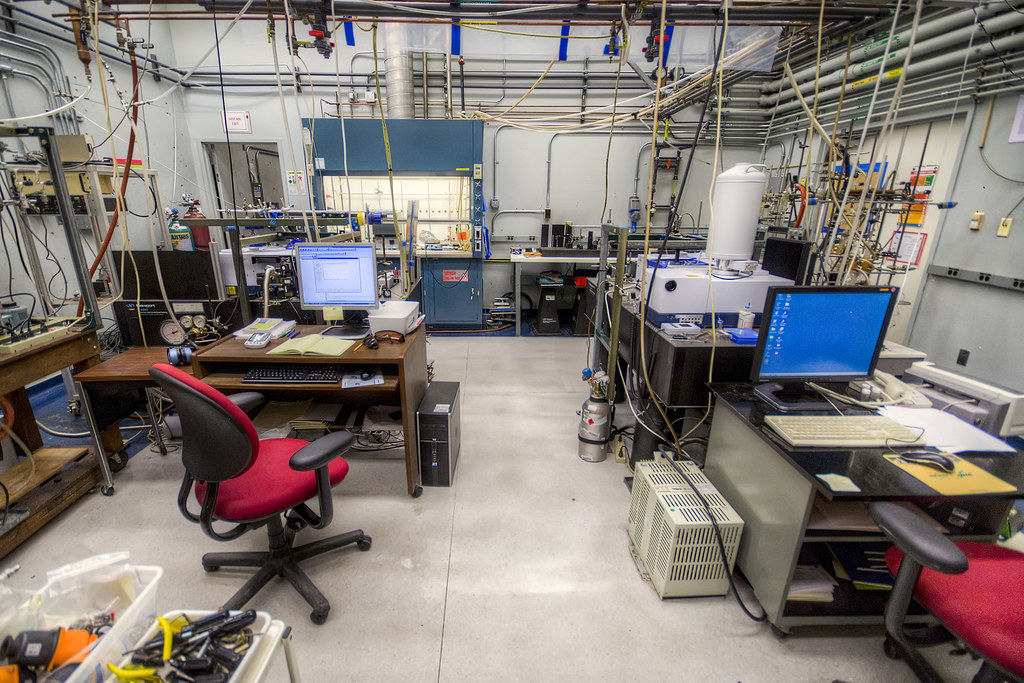
After spending my entire adult life as a laboratory scientist, the web of gas lines and vacuum pumps and electrical cable seems normal. I do understand, rationally, that all of this looks overwhelming. There’s so much purpose and productivity behind the network, however, that it’s worth the sophistication.
Self-Portraits of a Sabbaticaler
I’m interested in how scientists are depicted in media. They seem to always be in one of two modes. Either smiling at the desk with a screen and board filled with data/equations:
Or in the lab, with fancy apparatus and appropriate PPE. This may be real evidence of a sort of dichotomy in the lives of many working scientific professionals: some of the time is spent at a desk, doing the sort of email-answering/paperwork-submitting tasks that are common to many fields, but the rest of the time is spent in a more technical setting. I’d really like to see a broader view of how scientists spend their time. Could the whole breadth of the approach be captured in a single image, like some elaborate Baroque painting?