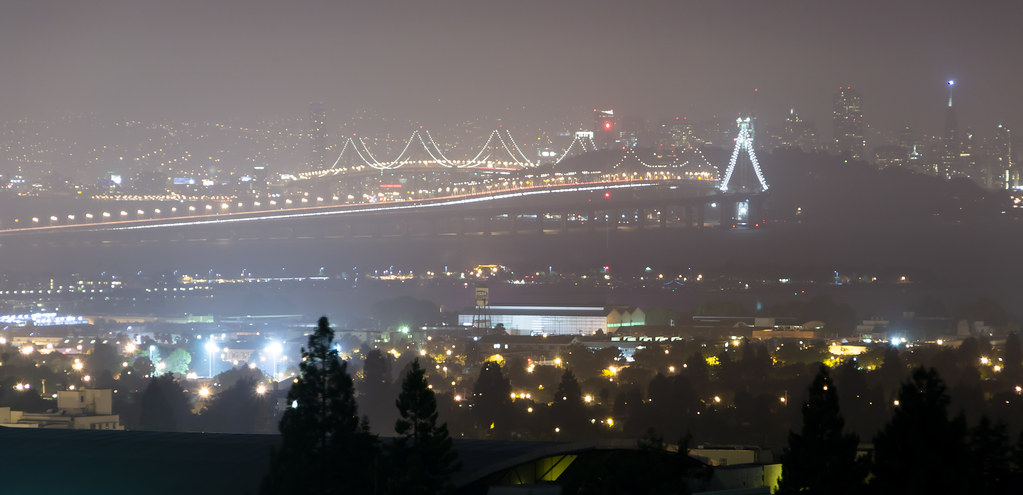
Maximum Effort 2024

I recently moved into a new office with a huge, boring, blank wall totally ready for a huge, interesting, dramatic landscape. That naturally meant returning to one of my favorite land/cityscapes, this view of Oakland, Berkeley, San Francisco, and Marin from sabbatical in 2017. For an image I expect to stare at for years to come, I really pulled out the stops in terms of producing the best possible image. Click through to Flickr to zoom in and get all of the details!

Maximum Effort 2024

Optical Sequence

For all of the fancy-looking holders and posts and hardware, an optical table is ultimately designed to put specific optics in front of the laser beam as it travels to generate a desired effect. This view of the space leading to our detector shows how many parts can accrue in pursuit of a given goal.

Optical Sequence

A Trip Back to Berkeley on the First Day with a New Camera

Scenery of Berkeley’s campus from Oppenheimer had me looking back again to my RAW files (as I’ve done recently) and finding exceptional images that benefited from my evolution in processing skills over the past decade. This particular December 2012 day marked my first walk to work with my then-new Nikon D7000, and so it was a moment in which I was viewing my quotidian surroundings through a literal new lens.

The light shining down on the little bridge over Strawberry Creek to the Faculty Club, for example, is a far more interesting image to me as a memory than it was at the moment I first processed these in 2012.

Quiet Bridge on Busy Campus

Quiet monuments, dappled by sunshine, feel different from a decade away.

Base of the Campanile

Big, dramatic, and green are the themes of this bridge.

Concrete Bridge and Arch

I was struck by how many portrait-orientation shots I had initially bypassed. The curving stairs in front of Latimer Hall always looked charming beneath late-autumn foliage.

Tree Over Stairs

These stairs down to Hildebrand Hall’s D Level were my typical path to my office. They were about as intimidating in real life as they look in this picture—squeeze between the edges of different intersecting buildings and utilities pass-throughs.

Stairs to the D Level

Leaving again at the end of the day, the afternoon sun on Latimer’s facade is starting to shift to an oranger hue.

Evening Light on Latimer

The trip past the architecture school wasn’t one I typically made by 2012 (I moved from an apartment south of campus to one on the west side), but the light on its concrete architecture wasn’t to be missed.


Gold Light on Architecture School

Relaxing with the Bay Area

Conserved spaces above the noisy East Bay grid make for this incredible reprieve. Though the street lights may shine up here, the sounds are damped over the distance. Lawrence Hall of Science is a popular spot to experience this; I like the contrast in this image between the humans and the city.

Relaxing with the Bay Area

Big Buildings and Little Ones

Trinity College Dublin’s campanile was the subject of my last post, but today I’ll bring it back to one I know a bit better. This photograph is another from my series of Berkeley pictures that I’m only now able to reveal with improvements in noise reduction technology. The effect of seeing this “lost” image recovered has me wondering what other moments—

Big Buildings and Little Ones

Eucalyptus Trails

Why save RAW camera outputs from (in this case) six years ago? Digital photography is a rapidly advancing field, and the advent of machine-learning-based noise reduction techniques has completely changed what sorts of images are salvageable. This lovely shot of Berkeley’s fire trails and tall (but invasive) eucalyptus trees stayed in the “unusable” pile for half a decade because I took it freehand, just after sunset, before I deployed my tripod—resulting in an ISO 4500 image from my old D7000 that was just too noisy. Topaz’s latest filters solved that and now this photo can take me back to my California sabbatical.

Eucalyptus Trails

Rogue AI Sunset

I’ve been excited about the possibilities of advanced algorithms in processing pictures, both to increase resolution and reduce noise. When used in combination on an initially noisy image, however, the results can be… unpredictable. Though this image looks fairly reasonable on the web page, clicking through to the full-resolution version on Flickr shows some exciting rogue AI strangeness—like odd places of varying noise reduction.

Rogue AI Sunset

The Future Wasn’t Already There, But Now It’s Evenly Distributed

My favorite William Gibson quote is, “The future is already here—it’s just not very evenly distributed.” How we gauge futurity—or how we identify the traits we associate with future-ness—means that some places will have more “future” to them than others. A mountaintop in the Adirondacks might be pretty similar to its condition 100 years ago, while downtown Berkeley would be unrecognizable.

This image is a picture of the past, from the “future”: I wanted to print a tall, vertical image of Berkeley and the Bay but had (it turns out) never quite taken the one I wanted. I had taken the two pictures that went into making this image as part of a larger panorama in 2013 that never quite came out. Here in the present, I pulled in every technique in my arsenal—Adobe’s super resolution, Topaz AI noise reduction, frequency separation—to assemble two images from a circa-2010 16 MP Nikon D7000 into the 76 MP monster you see below. This one is definitely worth clicking through to full resolution.

The Future Wasn't Already There, But Now It's Evenly Distributed

Every Detail of the Bay, Redux

This image is another in a series of my re-processings of less-than-new RAW files with Photoshop’s “Super Resolution” machine learning algorithm. As in those other cases, the added impression of detail is particularly astonishing when viewed at full size after clicking through to the original image on Flickr.

Every Detail of the Bay Redux