Muir woods, especially on a day with a bit of a drizzle, reminds me an awful lot of the good old pacific northwest.


HDR Photography
Muir woods, especially on a day with a bit of a drizzle, reminds me an awful lot of the good old pacific northwest.
Bit by bit, my memories of Berkeley are vanishing. I can justify that this phenomenon is, at worst, neutral: the daily grind and the stupid time I missed the bus vanish, and only the weekends watching the sunset from the Berkeley Hills remain. Not to be trite: this empty, early-morning, fog-shrouded, post-apocalyptic view of the campanile is now my memory of the place, as well as an operational metaphor for that memory… If that’s not too obtuse.

One of the undeniably good things about the bay area is the unwaveringly pleasant weather we experience here. Since it’s been so nice outside recently I felt compelled to post this shot I captured last spring.

Without being able to see the ocean below, it’s easy to forget how precarious this path is.

Early morning fog clings to the rocky-yet-verdant hills and cliffs of Muir Overlook, just north of San Francisco. Lichen-encrusted rocks and eerie, hanging trees capture moisture from the air. It’s not raining, but everything is “drippy.”

When you’re working with an ultra-high vacuum chamber, there’s no “popping down to the hardware store for a spare part.” Over the years, spares and replacements and antiquated equivalents and almost-still-good parts tend to accumulate in the cabinets of a physics lab. Cabinets start to look like set dressing in a sci-fi movie.

Looking south, over the rooftops and streetlights of downtown Berkeley, the high-rise buildings of Oakland and Emeryville are luminescent ghosts in the bay fog. I’ve come back to this photograph again and again—the composition isn’t quite right, the quality is just average, but for some reason I find it inescapable. I can forgive all of its sins (and mine in taking it) for the trajectory of those sodium lamps, arcing gently to the south like some fairy worm.

Perched atop the hill above UC Berkeley’s campus, overlooking the rest of the bay area, sits Lawrence Berkeley National Lab. Perhaps the most iconic building is the advanced light source, featured prominently in Berkeley lab’s logo. I was able to grab this shot from the fire trails above LBNL in the Berkeley hills.

Hyperbright hallways in the Energy Biosciences Building come straight from the set of a sci-fi movie. Between labs and storage space are cold room facilities like the one in the foreground of this photo, with its bank of controls on the wall outside. The research accomplished here lives up to the imposing appearance: the future of using biology to harness the Sun’s energy will be born here.

This one’s a little different, here I was playing around with a pinhole on my Canon T3i. This is actually a manually measured 3 shot HDR pinhole photo of a bridge on Cal’s campus. Composing this shot was a bit of a challenge as really the only way to judge composition is to take a long exposure (in this case not that long with the help of very high ISO settings). Processing it was also a bit of a challenge as the amount of change in the lighting over the duration of the three exposures created really weird looking highlights. Still, the peculiar kind of “lo-fi” quality is neat, and I’ve been experimenting with landscapes where the reduction in detail is less noticeable.

Across the San Francisco Bay, under the shadow of the East Bay hills, the Port of Oakland hums busily along. From far away and in the golden light of sunset, it’s easy to forget the sophisticated dance of distribution that keeps the urban tangle of the Bay Area alive.

Like Manhattan, San Francisco is largely trapped by water. Like Manhattan, the city has preserved large swaths of “natural” space (e.g. Central Park, Golden Gate Park) in that hyperdense urban mass. The Mediterranean climate, youth, and topographical preposterousness of San Francisco give it a unique (pardon the neologism) architexture. Looking west from the trees of Telegraph Hill, over Russian Hill and on to the Presidio and the Golden Gate Bridge, the cross-section of environments complement each other. My mind still struggles to see the towers of Russian Hill in the same image as the inhospitable rocks of Marin.

The stunning, overwhelming, almost-heartbreaking Muir Woods National Monument in California has become a photographic cliché. (Thanks, Ansel Adams.) That doesn’t prevent me from discovering something new in every corner and every moment. The incredible contrast of scale between ferns and sequoias twists the mind, and the quiet, misty paths (early in the morning anyway) transport you to an overwhelming alternate world.

A mid-winter shot down Telegraph Ave. to the heart of Oakland (from the top of Berkeley’s Campanile) is more nostalgia-tinged now than when I took it. And I do appreciate the way that this shot captures the Bay and the hills ringing it, the silvan suburbia of the East Bay, and even the oddly broad California streets.
Ultimately, even with the benefit of nostalgia, I still have mixed feelings about Oakland. In some ways, the existence of Oakland allows San Francisco to be an “unbalanced chemical equation,” pushing off many of its problems across the bay. Everything can still look peaceful from a distance.

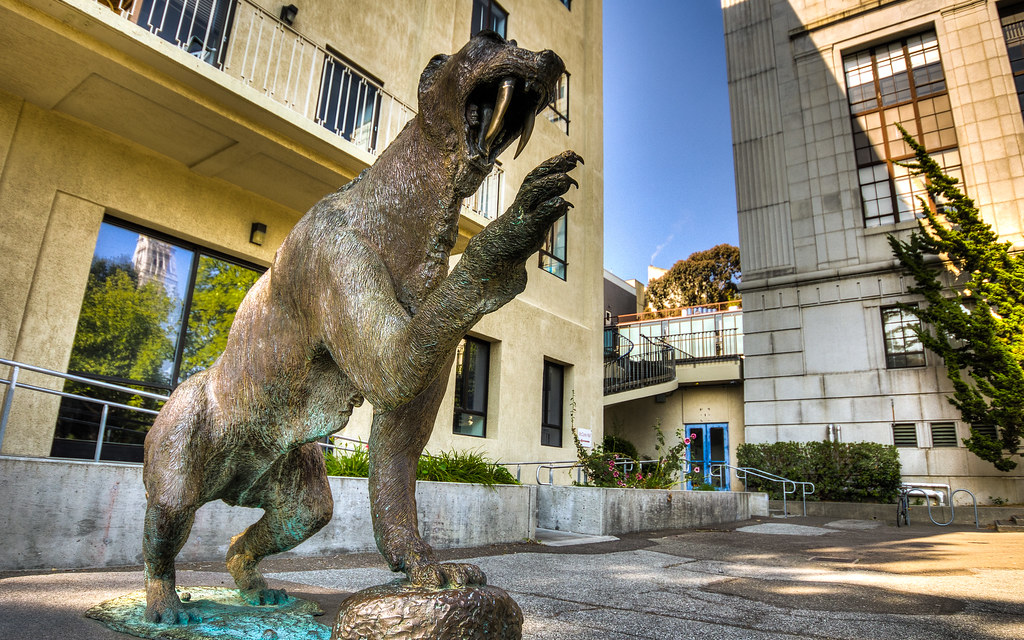
I certainly wouldn’t want to have come up against one of these in the wilds of prehistoric California.
 Decaseconds