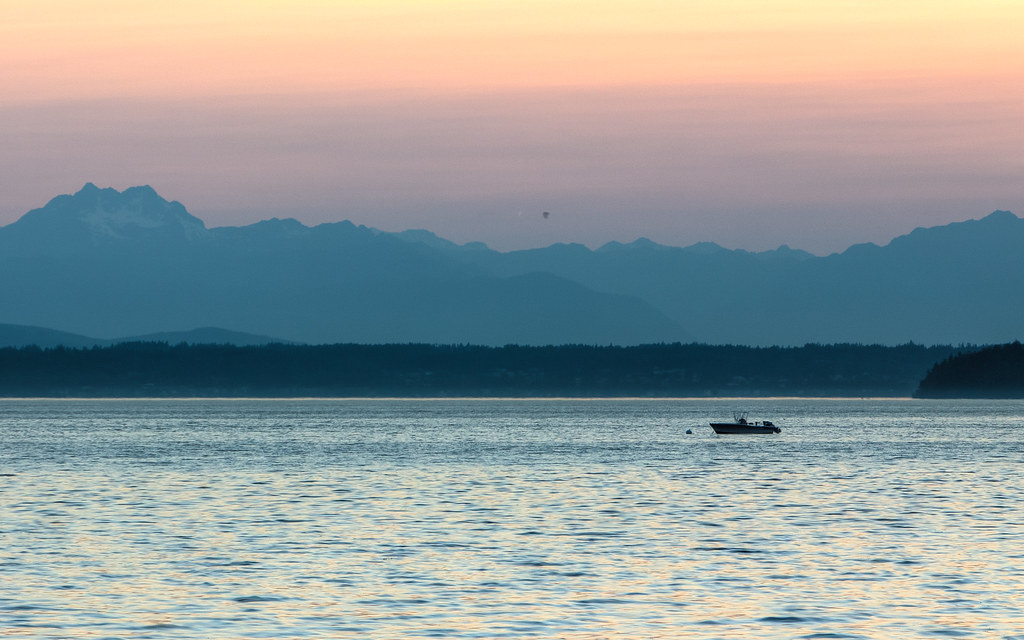
Simple Sunset

I suppose part of the reason that I appreciate landscape photography is its ability to capture a perfect, transient moment of incredible beauty. Of course, on some evenings (such as this one), the weather and environment just won’t cooperate. (I nearly titled this photograph “Boring Sunset.”) As photographer, I can put myself in the right place at the right time, but I still need reality to do its part.

Simple Sunset

Oregon Surfaces

The topology of central Oregon at sunset is really very special: the land somehow has that “falling away beneath you” feeling of standing on a hilltop, that “in the hollow” feeling of standing in a valley, and that “goes on forever” feeling of standing on a plain all at the same time. Combine this with the variety of surfaces and textures to experience (gravel, grass, tarmac, wood, lake, sky, woods), and the experience becomes some hyperdimensional superposition of places and moments in time. With just the right car for the particular evening, you have a recipe for perfection.

Oregon Surfaces

Hills of British Columbia

Outside Vancouver (the city) are the hillsides, dotted with homes and apartment buildings and, farther north, massive rocks. (That’s a pretty rare combination.) The difference between the soft, welcoming pink hues of the sunset and those massive hillsides (with some lovely evergreens in the foreground) is stranger, the more I think about it.

This picture also illustrates the biggest difference I’ve encountered since moving from the west coast to the east: the environments are less staggering and overwhelming, but the skies (and the buildings) are much more so. I’ve had to reorient the way I shoot to account for it.

Hills of British Columbia

Civ Gradient

I often talk about the “civilization gradient:” the distance required to go from high-density urban land all the way to empty, rural space. Depending on when a given area modernized and switched from, say, horses to cars, this distance can vary drastically. In “older” parts of the US, like the east coast, the gradient was largely established by feasible distances for travel by horse. On the west coast, an area largely developed after the advent of the car, this distance is usually much longer. The best exception to this is the Bay Area, where various parks around the “lip” of the Bay’s “bowl” effectively compress the distance.

In today’s photo, the whole array of Bay Area landscape is visible: the forests and trails along the peak, the industrial buildings of Lawrence Berkeley National Lab, the quasi-sprawl of Berkeley and Emeryville, and the full urban metropolis of San Francisco at the edge of the clouds.


Civ Gradient

Crashing Wave Path

Far along the beach, the Atlantic waves crash against Brazilian stone. The Sun has just dropped behind the horizon, and I’m standing on these steps beyond a strange little pseudo-bridge and this odd sculpture. To this day, I’m still not sure whether it’s functional, or purely decorative.

Crashing Wave Path

Vancouver Sky

There’s something magnificent about the views around Vancouver of the hills and the water. There’s something even more amazing about those same views around sunset when the sky just absolutely fills with color. For these reasons, among others, Vancouver’s got to be one of my favorite places on this planet.

That and if you walk around long enough you start to recognize locales featured in MacGyver.

Vancouver Sky