This tiny island sits in Tupper Lake’s appropriately named Rock Island Bay, amid this quintessentially Adirondack-y landscape of rolling hills and coniferous trees. This particular island has always been notable to me because of the degree to which it aligns with my boyhood ideal of “where to hide out.” Swimmable, but just barely for a 10-year-old, from the shore. A tree for the barest shelter and a twig, now and then, from which to craft a fishing hook. When the day of adventures is over, a little island like this one would be just big enough for a boy-sized lean-to for my childhood self. Wouldn’t that be paradise?
Tag: Nature
The Fall and the Pool
A year ago, I stood atop this waterfall in the corner of Connecticut, relaxing and hiking in the last few days before I traveled north to Canton to begin the faculty life. There are three things that this image captures:
- So many waterfall pictures use a long exposure to smooth the water into some blurry, surreal, Platonic ideal of flow. The effect might be pretty, but that effect is also a lie about the true experience of the crashing and splashing. Let’s get some spray in here!
- Poetically standing atop a waterfall in a wood, with a calming pool nearby, seems to me less a cliché than something that is consistently authentic across the American experience.
- Nostalgia may power a lot of my images, but it’s a force that only works retroactively. I would feel very different about the image if I’d promptly slipped and trashed my camera. Can that “dodged danger” exist within the image itself?
Redwood Creek Is Calm on a Rainy Morning
Deer Play
That perfect, after-dinner dusk moment: the deer (and the bugs) are out to play, and everything is quiet in the last un-Rayleigh-scattered rays of sunlight. Among the weathered fenceposts and glacier-carved rocks, deer are out to play. I’m interested by the idea that children play, and animals play, but the idea of “play” as something that adult humans do takes on a different meaning in the context of adult human culture. The concept of responsibility brings with it a parallel idea that to play is to behave irresponsibly, doesn’t it?
But don’t dwell on that. The sunset is enchanting and the deer are having fun. I will, too.
Four Images of Fermilab Prairie
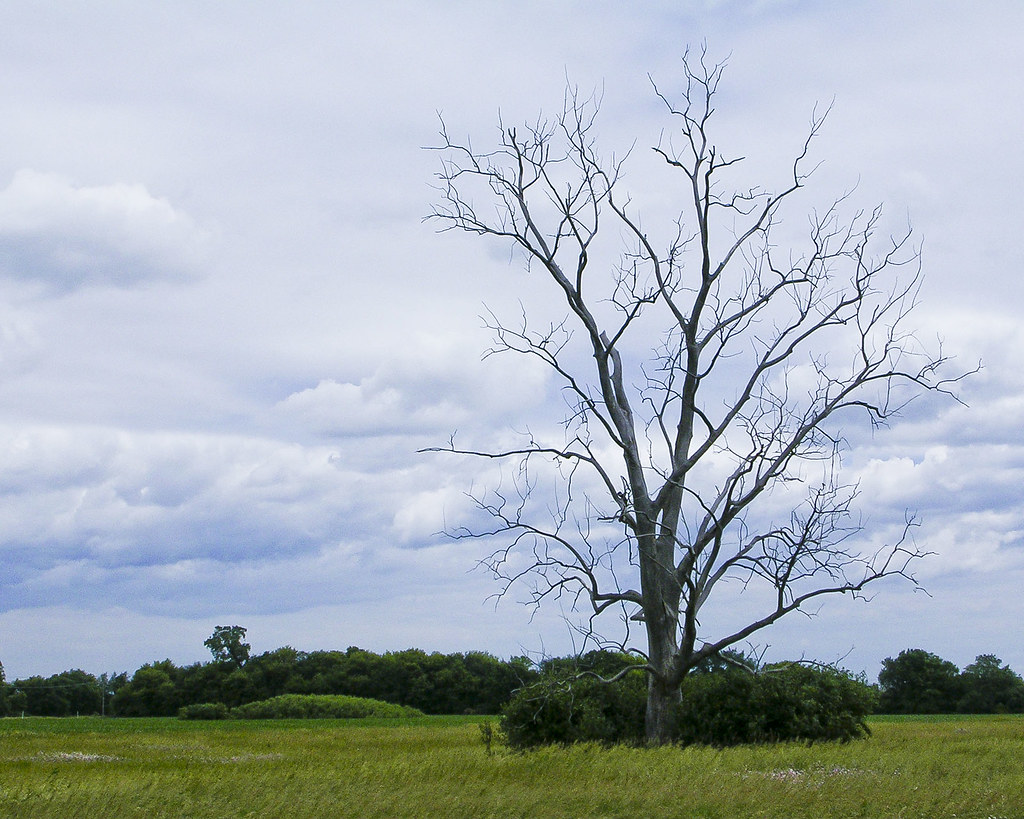
For 28 years, the Fermi National Accelerator Laboratory in Batavia, Illinois was the site of the now-dormant Tevatron particle accelerator. For three summers during high school and college, I worked in the archives there, helping to catalogue, maintain, and restore the physical history of the place. (Given the time frame of today’s pictures—the early 2000’s—you’ll forgive the poor image quality.) I wanted to share a few images of the place (in particular, its enormous swaths of restored prairie) and try to convey to you the everyday feel of the place.
Perhaps the most salient feature of the lab is the prairie itself. Other than a berm over the accelerator, a few tangential buildings, and the main complex, the vast majority of the 6,800-acre site is natural midwestern landscape, dotted with disused farms and watched over by birds of prey.
The reason for the old farms and strange buildings is linked to the provenance of Fermilab: in the early 1960s, towns competed to be the site of the latest and greatest national lab. The town of Weston, Illinois won the honor, and in doing so, ceased to exist. The residents were bought out (by the choice of their village board) and the remnants of the village still exist on site as ancillary buildings (including the archives, where I worked.)
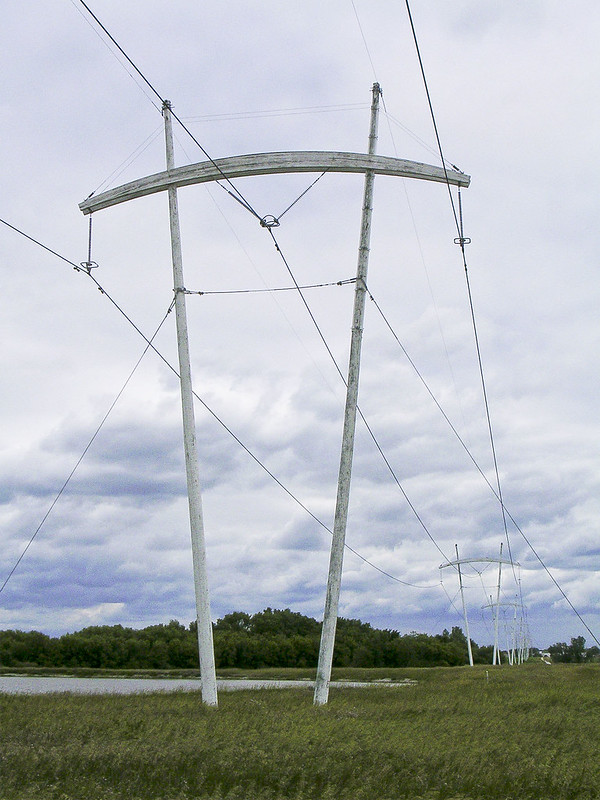
The farmland was largely restored to prairie, and the unique buildings of the lab were assembled. Among the fascinating sights at the lab are these Shinto-influenced power lines, designed by the lab’s first director, R.R. Wilson. (He was also responsible for the lab being finished on-time and under-budget.)
Wilson Hall, seen in the distance of this landscape, was named in his honor. Here you can see some of the lab facilities proper, including a beamline on the left of the image.
Muir Woods Has Wood Pathways
I may continue to bemoan the theme-park-like atmosphere of Muir Woods by midday on Saturday, but in the very early morning, with dawnlight scattering through the marine layer, it’s easy to forget about all that. There are no words to describe the place without resorting to cliché. Even so, the echoes of “Six Flags: Muir Woods” still exist, like these wood pathways designed to lessen the destruction that would be caused by enormous numbers of visitors on dirt paths.
Ice Appears
Along the Mass Pike in central Massachusetts, early spring means massive walls of ice where the road cuts through hillsides. I really like the way this image is just a bit more cropped (largely because I was using a prime lens) than I might normally shoot the picture. Ice and rock FILLS the frame, with just a small amount of sky and trees on the left edge to provide a sense of scale.
Druid Country
Though it’s hours downstate from where George Lucas found his forest moon of Endor, Muir Woods packs the same enormous, wet redwood trees and lush vegetation that made the fictional planetoid so memorable. To have “spent” so much of my childhood wandering around on that other world (in my imagination), only to find myself really there, proved to be a spectacular treat at the end of my time in California.
Weaver Finch Apartment Complex
Infinite African Hills
Breakfast Run
As a spectroscopist and inorganic chemist, I’m constantly encountering symmetry and its effects. From the balanced shapes of molecules to the bilateral formation of our own bodies, nature is full of symmetry that informs its function and behavior. In addition to symmetry in physical space, the kind with which we are most familiar, there is also symmetry in the dimension of time. Some examples are rather uninteresting from an “elegant universe” perspective: the cycles of alternating current exhibit high symmetry, but hide under the surface of our everyday electronics.
The cycles of seasons, on the other hand, have been on my mind lately as the North Country oscillates rapidly between spring and winter. (One day on, one day off.) In those cycles, I’ve found a strange symmetry. Though most of the year lacks reflection symmetry (autumn is obviously different from spring), there’s a point where late fall lines up perfectly with early spring—the world is cold and still and brown, and I can pretend for a moment that the winter never happened.
The Aloe Hill
Trips through Zulu Nyala went out morning and evening, and as such we experienced some fantastic late-morning and early-evening scenes. (Particularly if, as on this afternoon, a massive rainstorm had just occurred.) This particular vista includes the mysterious aloe hill, where the other savannah foliage is mysteriously absent, with only the alien aloes remaining. An invasion? Could be.
Cheetah Portrait
I had an up-close-and-personal, early-morning meeting with this particular cheetah in Zulu Nyala. (She wears a radio tracking collar so that vets can care for her and her offspring.) Staring into the face of evolution’s high-velocity interceptor on a rainy morning is a more effective wake-up than 100 cups of coffee.
Lincoln Park
Hillside in Eden
The herds of impala in Zulu Nyala Reserve have almost no fear of the people who come to see them. During the wet start of the summer, that leads to scenes like this one: a verdant savannah hillside, dotted with impala and craggy trees and brushed by the breeze. I start to think that there could be no danger to ever disturb this peace—even if I could see the inevitable cheetah hiding in the grass.