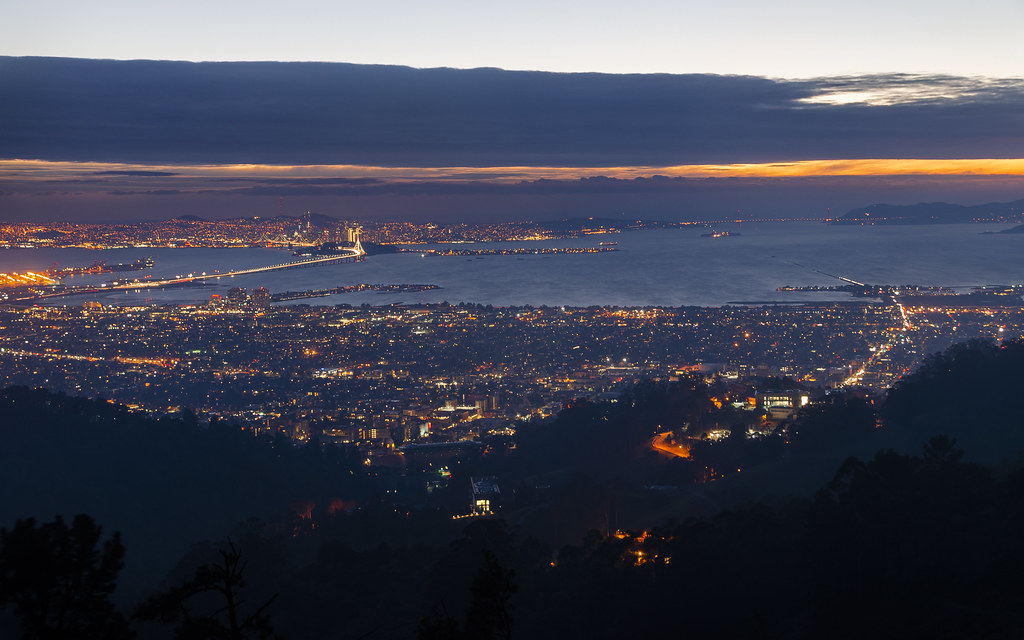
I recently moved into a new office with a huge, boring, blank wall totally ready for a huge, interesting, dramatic landscape. That naturally meant returning to one of my favorite land/cityscapes, this view of Oakland, Berkeley, San Francisco, and Marin from sabbatical in 2017. For an image I expect to stare at for years to come, I really pulled out the stops in terms of producing the best possible image. Click through to Flickr to zoom in and get all of the details!
Tag: Bay
Relaxing with the Bay Area
Big Buildings and Little Ones
Trinity College Dublin’s campanile was the subject of my last post, but today I’ll bring it back to one I know a bit better. This photograph is another from my series of Berkeley pictures that I’m only now able to reveal with improvements in noise reduction technology. The effect of seeing this “lost” image recovered has me wondering what other moments—
Eucalyptus Trails
Why save RAW camera outputs from (in this case) six years ago? Digital photography is a rapidly advancing field, and the advent of machine-learning-based noise reduction techniques has completely changed what sorts of images are salvageable. This lovely shot of Berkeley’s fire trails and tall (but invasive) eucalyptus trees stayed in the “unusable” pile for half a decade because I took it freehand, just after sunset, before I deployed my tripod—resulting in an ISO 4500 image from my old D7000 that was just too noisy. Topaz’s latest filters solved that and now this photo can take me back to my California sabbatical.
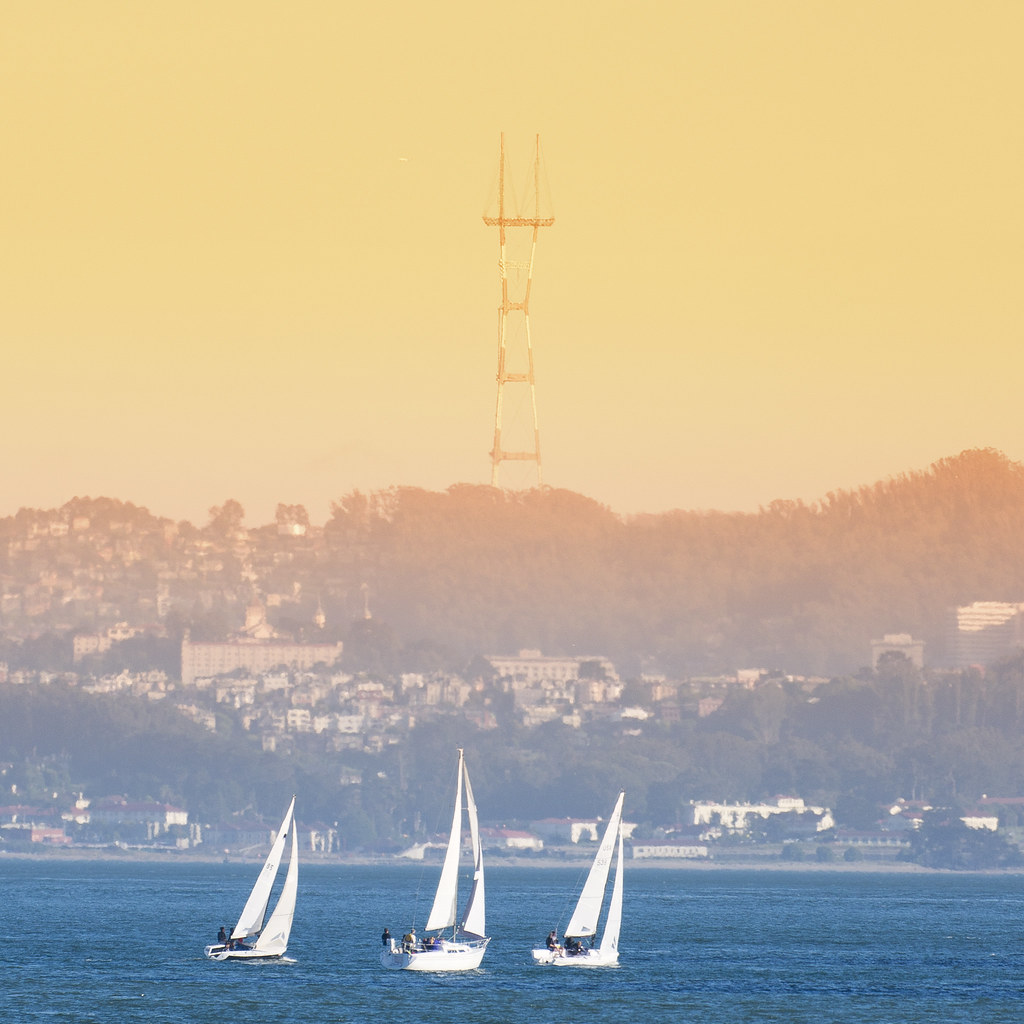
Sailing Beneath Sutro Tower
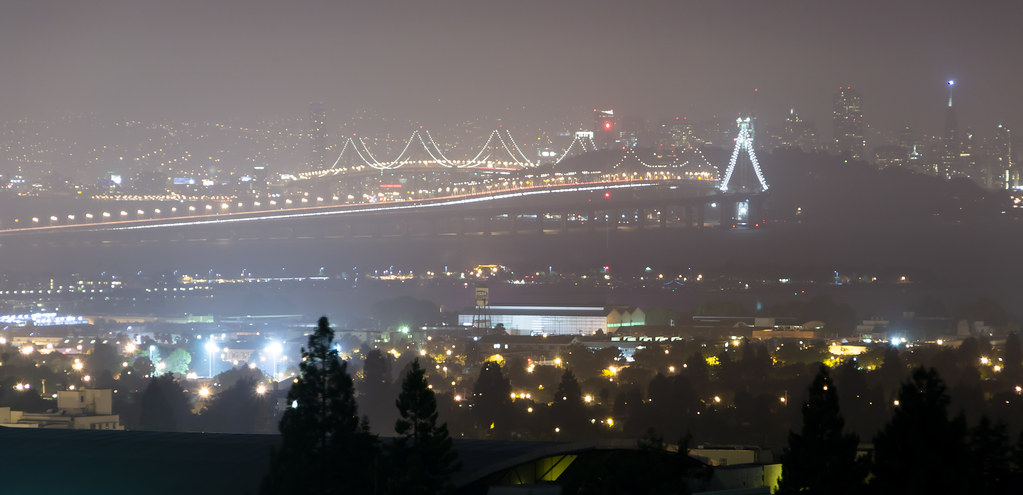
Nightfall on the Western Span
The Future Wasn’t Already There, But Now It’s Evenly Distributed
My favorite William Gibson quote is, “The future is already here—it’s just not very evenly distributed.” How we gauge futurity—or how we identify the traits we associate with future-ness—means that some places will have more “future” to them than others. A mountaintop in the Adirondacks might be pretty similar to its condition 100 years ago, while downtown Berkeley would be unrecognizable.
This image is a picture of the past, from the “future”: I wanted to print a tall, vertical image of Berkeley and the Bay but had (it turns out) never quite taken the one I wanted. I had taken the two pictures that went into making this image as part of a larger panorama in 2013 that never quite came out. Here in the present, I pulled in every technique in my arsenal—Adobe’s super resolution, Topaz AI noise reduction, frequency separation—to assemble two images from a circa-2010 16 MP Nikon D7000 into the 76 MP monster you see below. This one is definitely worth clicking through to full resolution.
Bridge Construction in the Fog
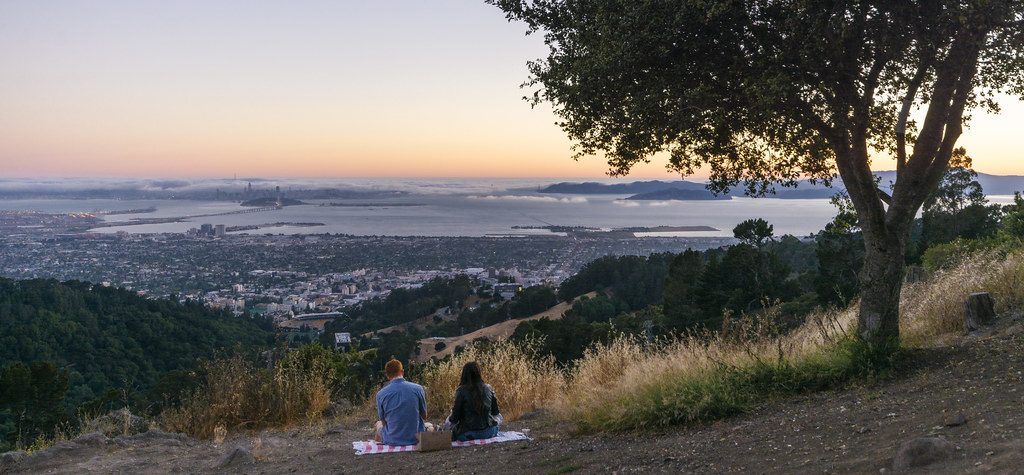
Picnic with the Bay
Trees and City
The East Bay’s tree-lined streets make for a calming juxtaposition with “cloud city” wall of buildings and marine layer across the water.
Sather Tower and San Francisco
In the United States, the ubiquitous Neo-Gothic architecture of college campuses is an intentional throwback to far more ancient campuses in Europe. From a present-day perspective, of course, the “new” campuses of the east coast have existed for long enough that the anachronistic campuses now blur into a single time period called “old”. On the west coast, however, structures like Berkeley’s Sather Tower (a.k.a. the Campanile) are clearly artificial additions in the otherwise-contemporary landscape.
Civ Gradient Redux
Going back over some of my favorite images with “Super Resolution,” there’s no way I was going to skip a second shot at my image that first captured the “civilization gradient” from nature through suburbs to dense urbanity.
Final Light Redux
Berkeley Lab Super Resolution
Extracting additional information from an image by “enhancing” it has long been a ridiculous trope of police procedurals; it’s with great amusement that I noticed that Photoshop’s new “Super Resolution” capability (which uses machine learning to quadruple the resolution of an image) is under an option called “Enhance”. The first subject for enhancement was this picture I took of Berkeley and San Francisco in 2011. It’s worth the click-through for the full resolution version.
(Adding to the super-resolution theme, this image also contains, in the lower-center, the Molecular Foundry and its associated center for electron microscopy.)