Air-free chemical processes require specialized apparatus like the glass Schlenk line inside this dramatically lit fume hood.


HDR Photography
Air-free chemical processes require specialized apparatus like the glass Schlenk line inside this dramatically lit fume hood.
Photographing progress in the research lab can be so useful for answering that future question: “Did it really look like this last time we ran this experiment?” Our memories are imperfect, but so too is an image of a sample if one adjusts the processing settings to amplify saturation or contrast beyond reality. Sometimes, the goal of capturing something true to life overlaps with capturing something aesthetically pleasing, and then I have to share this image of freshly synthesized nanopowder clinging via static electricity to the end of a glass stirring rod.

I often capture pictures of my scientific work in progress, allowing me to better explain my protocols to others. In this case: a partial pellet of pressed silica nanoparticles in the center of my 3D-printed gas cell, sealed behind orange-colored zinc selenide window that blocks UV light from escaping.

A shot of a basically antique lathe from back in the Berkeley student machine shop. New or old, that chuck needs to keep the part in place when it spins up to speed—and it definitely did.

I captured this image more than a decade ago to show the pleasing trio of power receptacles mounted to the wall behind our boxed-up laser system, but I was also inadvertently capturing a kind of self-portrait in the reflection of my legs and tripod in the polished laser box panel.

Retroreflectors are used in optics to send a beam of light back from whence it came. While this can sometimes involve laborious alignment of adjustable mirrors, these custom-built “zero degrees of freedom” mounts hold the high-reflector mirrors against perfect-90º prisms to guarantee the correct geometry.


When one of my research students needed to dose a large number of samples with bipyridine, they came up with this ingenious approach to running the process in parallel in our sonicator. I was impressed.

A well-stocked and well-arranged chemistry lab tends to accumulate localized collections of one specific part that wind up looking like a page from a scientific supplies catalog.

Over the course of the past two years, I’ve used OpenSCAD to design a gas/vacuum cell that can support a pressed silica nanoparticle pellet in front of a variety of spectroscopy systems. The core of the cell was 3D printed in aluminum by Shapeways, with some subsequent facing on our lathe to get good seals with the O-rings. This first version is designed to fit into our fluorimeter.
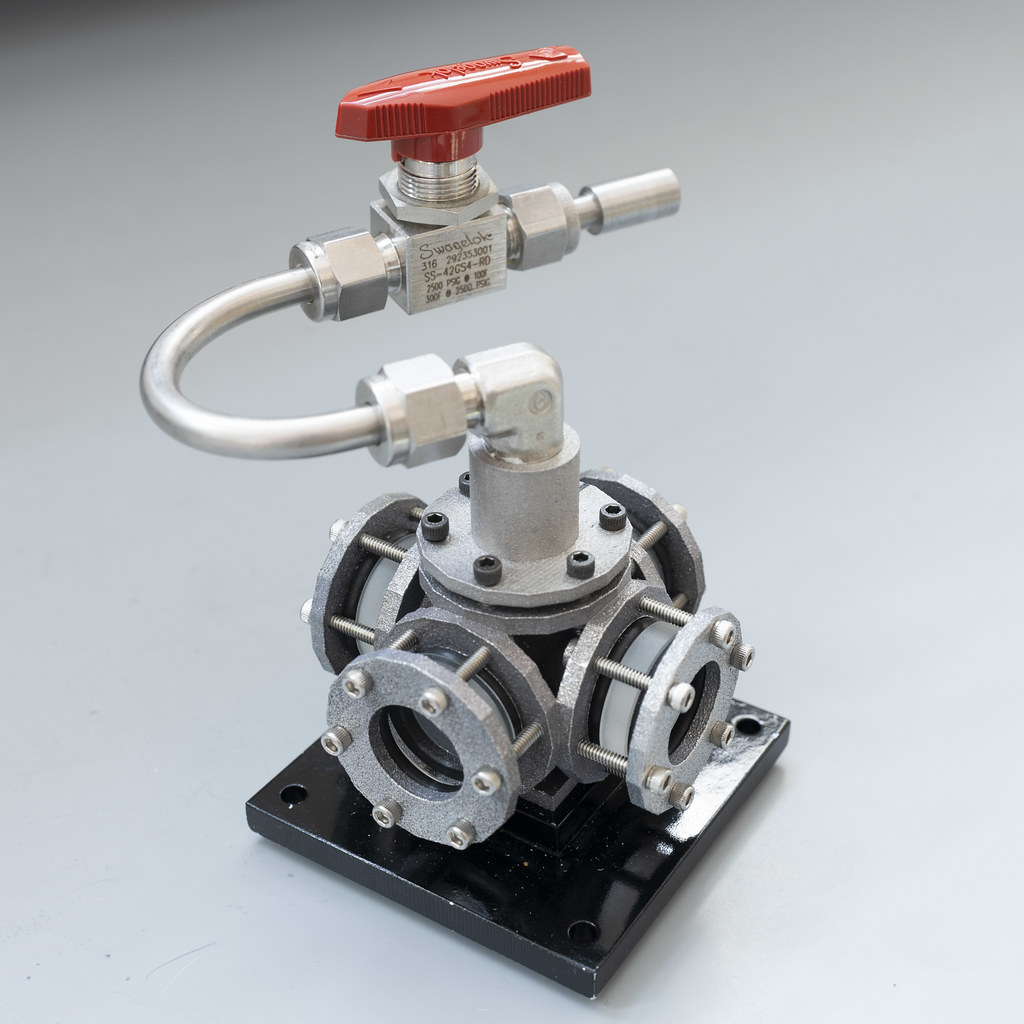
After using the first cell for a year, I realized I also wanted to be able to attach it to a fiber-optic-based spectrometer. Here, you can see the second cell attached to our Schlenk line.

This is my Schlenk line; there are many like it, but this one is mine. The double-manifold design allows my students and me to expose samples to either vacuum or inert gas (argon, in this case.) Every line has little tweaks and customizations made by the scientist using it, and is thus inevitably a work-in-progress. This particular line very much needs a full-time vacuum gauge as its next addition.

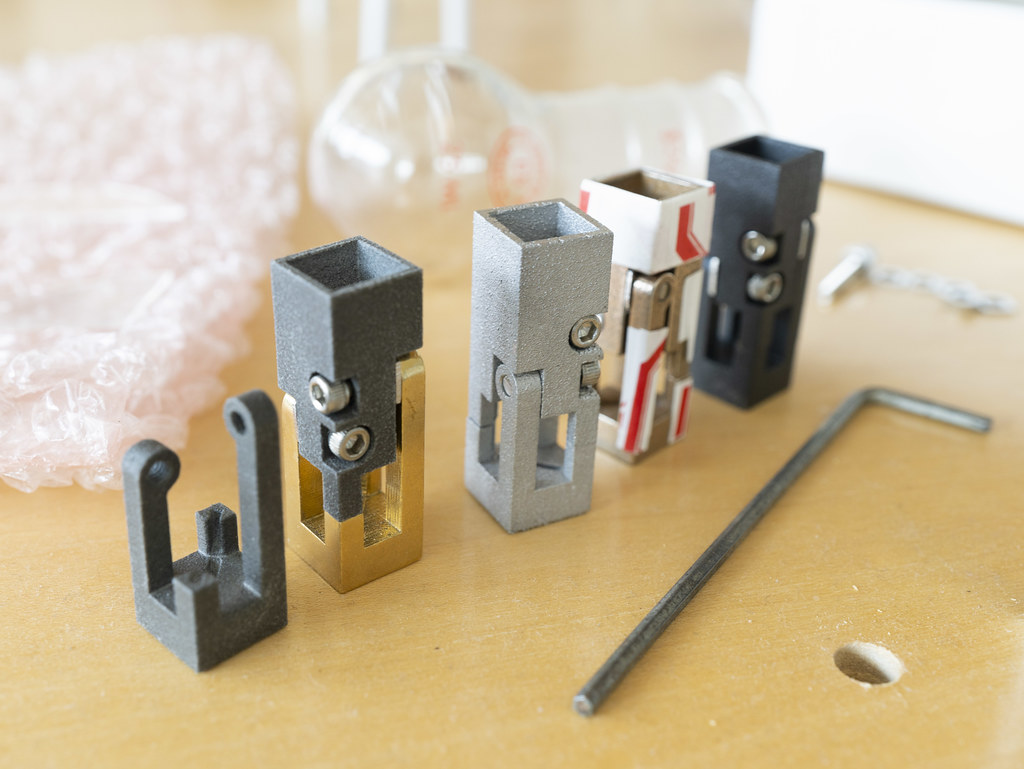
In addition to photography, I’ve been exploring 3D printing in the past few years. I’ve found that it’s a great route to making small objects to support my science work. In this case, I was developing a holder to support a 12.7 mm pressed solid sample pellet inside the space normally occupied by a 10-cm pathlength liquid-handling cuvette. The result is this odd rectangular shape that unlocks to hold the “too wide” pellet diagonally—thanks, square root of two!
In these forms, I was working with a variety of materials, including glass-reinforced nylon, lost-wax-cast brass, and a bronze/steel powder combination.
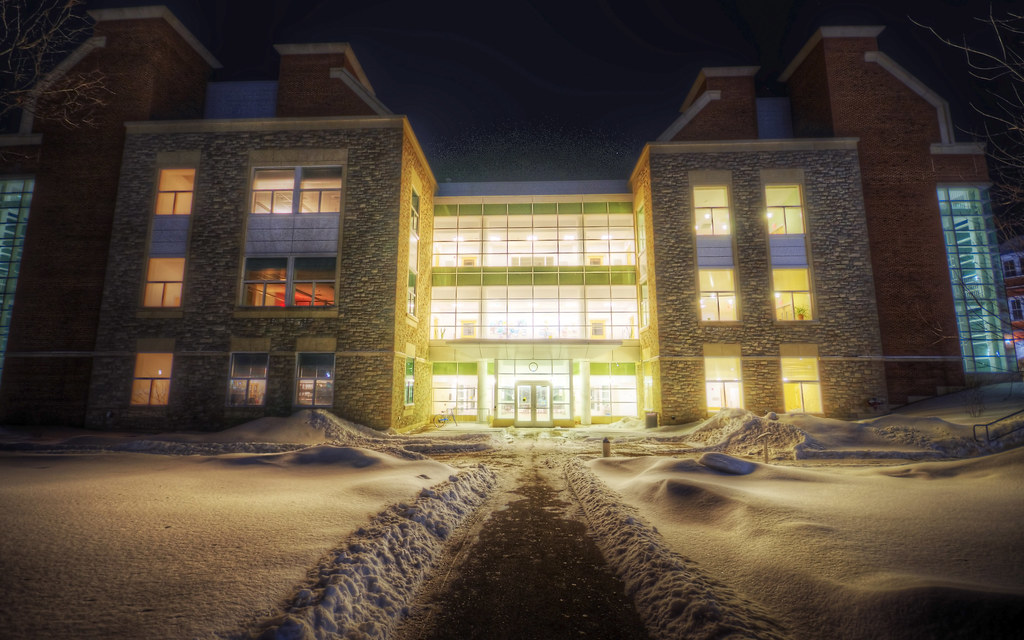
I often show what I think of as the front of Johnson Hall of Science, but inspection of this image (particularly the top of the brick wing on the left) shows that the building’s name, and thus its front, are on this side. The dramatic glass structures extending between and out from the wings lend credence to the idea.

Blankets of snow look good around St. Lawrence University’s Johnson Hall of Science.
The hours I spend in the physics and chemistry labs of St. Lawrence University make me a bit inured to the optical shenanigans occurring when we take Raman spectra of the materials my students synthesize. Still, the effect is pretty fantastic. The grainy pattern of the laser on surfaces around lab is fantastic, but the fluorescence ink on the post-it note in the foreground fluorescing aggressively is pretty cool, too.
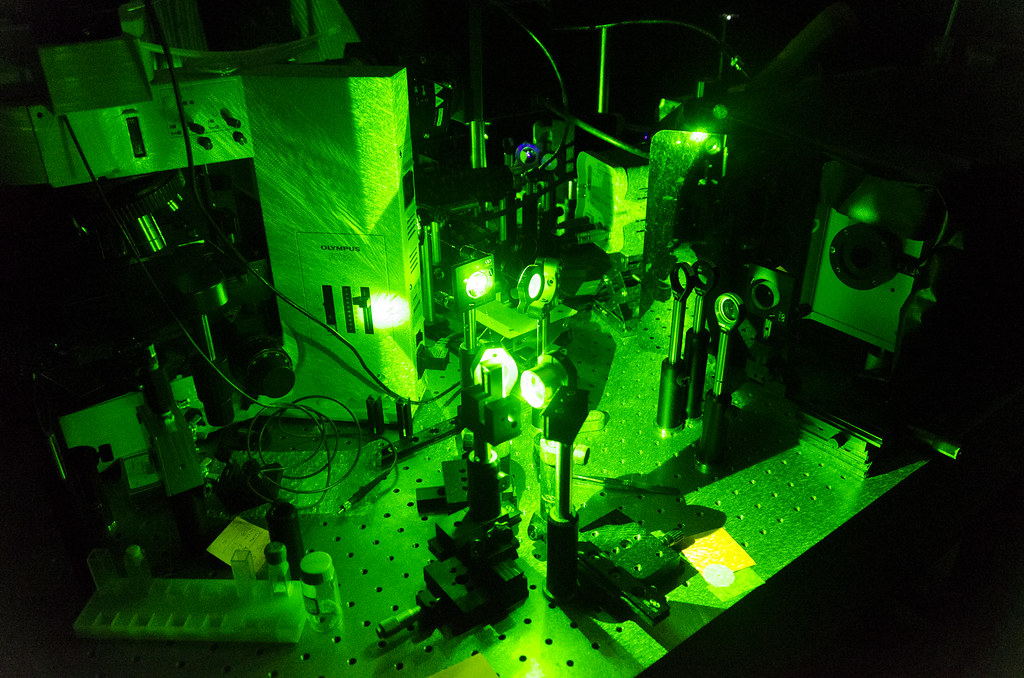
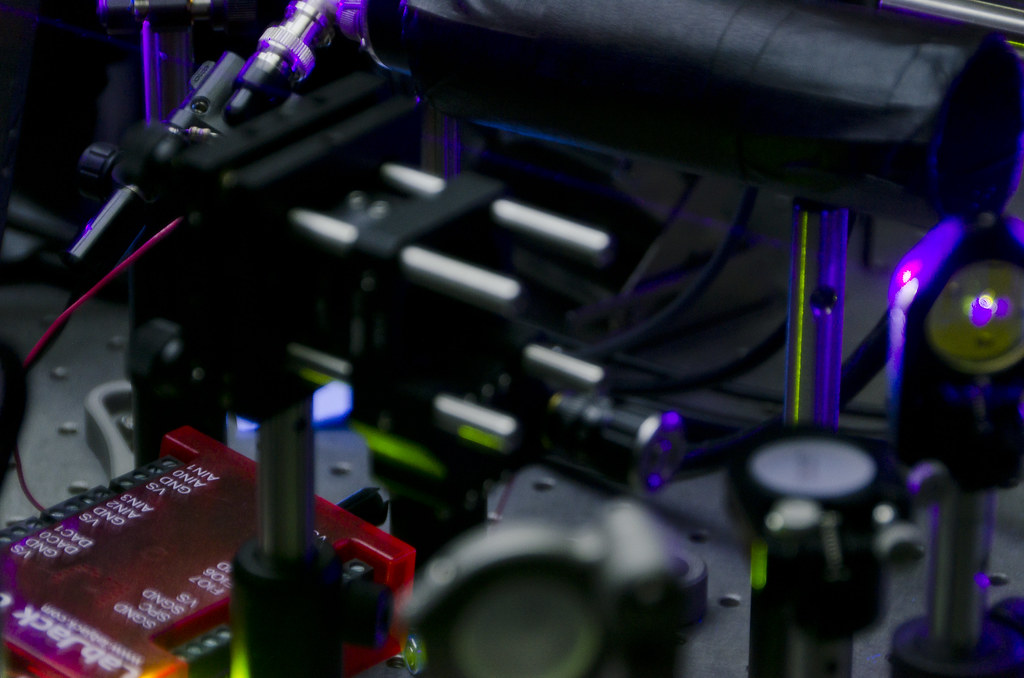
That violet-blue light in the background of the shot above is the 405 nm laser we use to initiate photochemical processes. The beam is poorly detected by the camera’s sensor, but the slightest hint of it is visible in the upper third of the image below.
I’ve been capturing images of Johnson Hall of six years, and though the building itself stays the same, the trees outside have shifted and grown (and some died) over time. Time marches on.

 Decaseconds