Like most infrastructure, a roof is something one generally ignores so long as it is functioning as expected. A heavy melt of snow, however, might call all of that into question. At least the view is good from up here.


HDR Photography
Like most infrastructure, a roof is something one generally ignores so long as it is functioning as expected. A heavy melt of snow, however, might call all of that into question. At least the view is good from up here.
While we’re contemplating the architecture of Clement Chemistry Building, I don’t think I’ve previously considered the way in which the dark sculptural stone sections connect together the windows on the second and third floors to make these big, tall, dramatic, dark pillars up each side of the building—almost reminiscence of the tall stained-glass windows of a cathedral.

There’s nothing like Clement Chemistry Building’s dark-academic library as a place to literally cloister oneself in the days leading up to a big final exam in the end boss of chemistry: Physical Chemistry.

Continuing where I left off, the end-of-semester highly distracting snowfall on Trinity College was a perfect temporary respite.


The warm sodium glow of Trinity College’s campus by night—Clement Chemistry Building and Raether Library in the foreground, the chapel and the Hartford skyline in the background—highlights (in a literal, X-marks-the-spot manner) the contrast between being a student and a faculty member here. Though the same institution, the same general campus, I spend my time now in completely different places than I once did. A prime example is the X-marked courtyard between the two buildings—a place I walked through perhaps 10 times total as a student, but where I now pause for coffee with my colleagues nearly every morning.

I was searching for a cork to fit an opening in a piece of old-school chemical glassware. In the farthest-away, most-remote corner of an old chemistry lab was simply a drawer labeled “corks”; inside, I found an expansive sea of every possible cork diameter. Nothing more, nothing less than every cork—I felt like I had cast some sort of obscure seeking spell that brought me a “be careful what you wish for” volume of results.

Clement Chemistry Building is surrounded by flowering plants that complement its red stone structure on perfect spring morning.

The bold gothic shapes of Clement Chemistry Building are extra-sharp beneath a layer of snow and scattered with golden sunset light.

Perfect, breezy, warm, and effulgent spring days have sprawled across Trinity’s campus, rather like students on the quad. Grading papers in my office can at least be softened by an open window and the resulting smell of flowers.

Warm golds and deep reds match autumn skies and Trinity’s neogothic architecture.

Thanksgiving Break is upon us and Clement Chemistry Building is (mostly) quiet.

Following principles of green design, St. Lawrence University’s Johnson Hall of Science was built facing north-south, such that light throughout the day could be used to light rooms on both sides. The inner courtyard even features a light stone facade to help bounce more light into the inner offices. (I can attest that this works.) When the rest of the campus was constructed along the local street grid, rather than the compass points, the result is that JHS looks like a bit of a rebel among its neighbors.

A well-stocked and well-arranged chemistry lab tends to accumulate localized collections of one specific part that wind up looking like a page from a scientific supplies catalog.

This is my Schlenk line; there are many like it, but this one is mine. The double-manifold design allows my students and me to expose samples to either vacuum or inert gas (argon, in this case.) Every line has little tweaks and customizations made by the scientist using it, and is thus inevitably a work-in-progress. This particular line very much needs a full-time vacuum gauge as its next addition.

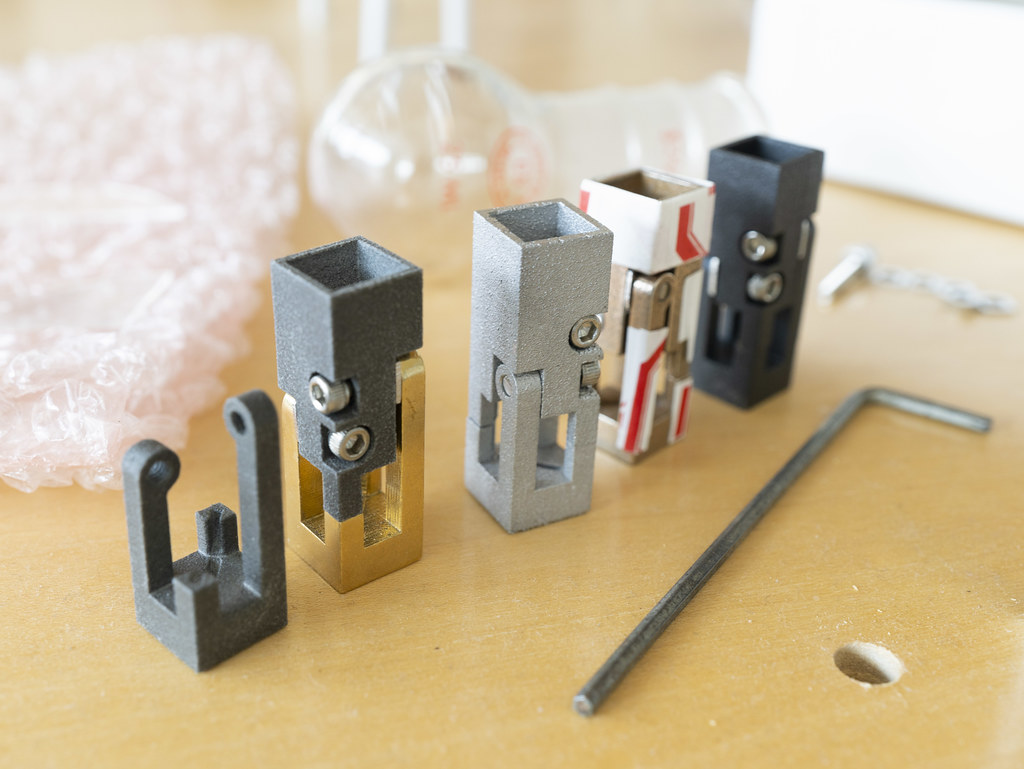
In addition to photography, I’ve been exploring 3D printing in the past few years. I’ve found that it’s a great route to making small objects to support my science work. In this case, I was developing a holder to support a 12.7 mm pressed solid sample pellet inside the space normally occupied by a 10-cm pathlength liquid-handling cuvette. The result is this odd rectangular shape that unlocks to hold the “too wide” pellet diagonally—thanks, square root of two!
In these forms, I was working with a variety of materials, including glass-reinforced nylon, lost-wax-cast brass, and a bronze/steel powder combination.
 Decaseconds